
In a culture of fragmented expression and algorithmic noise, Hybrid Collapse stands out as a rare totality — a project where sound, image, and thought converge. Blending AI-generated visuals, experimental music, and philosophical texts, it offers not just art, but a system for navigating identity, control, and collapse in the posthuman age.
In an era of fragments — fragmented attention, identities, cultures, and platforms — Hybrid Collapse appears as something rare: a total work. It is not just music, not just visuals, not just theory — but an integrated system where each layer deepens the next. A hybrid, yes — but not a patchwork. Rather, an aesthetic engine that turns collapse into coherence.
Drawing on philosophy, sound design, algorithmic image-making, and critical media practice, Hybrid Collapse rethinks what it means to create meaning in a posthuman age. It is immersive, intellectual, cinematic, and deliberately unsettling. It refuses to entertain without also challenging — and in that refusal, it offers a cultural form fit for the complexity of the present.
Not Just a Project — A Mechanism
Hybrid Collapse is built on a triadic structure:
-
Music as emotional architecture
-
AI-generated visuals as symbolic narrative
-
Theoretical texts as conceptual infrastructure
Each track in the debut album Biopolitics is accompanied by an AI-based music video and a short essay, forming a triangle of experience. You listen, you watch, you reflect — and only through this layering does the full picture begin to emerge.
This structure is not decorative. It mirrors the hybrid condition of the contemporary subject: emotional, visual, intellectual — but fractured. Hybrid Collapse doesn’t resolve this fracture — it maps it. It invites the viewer into a system where sound becomes ideology, images become questions, and theory becomes an emotional undercurrent.
Aesthetic as Argument
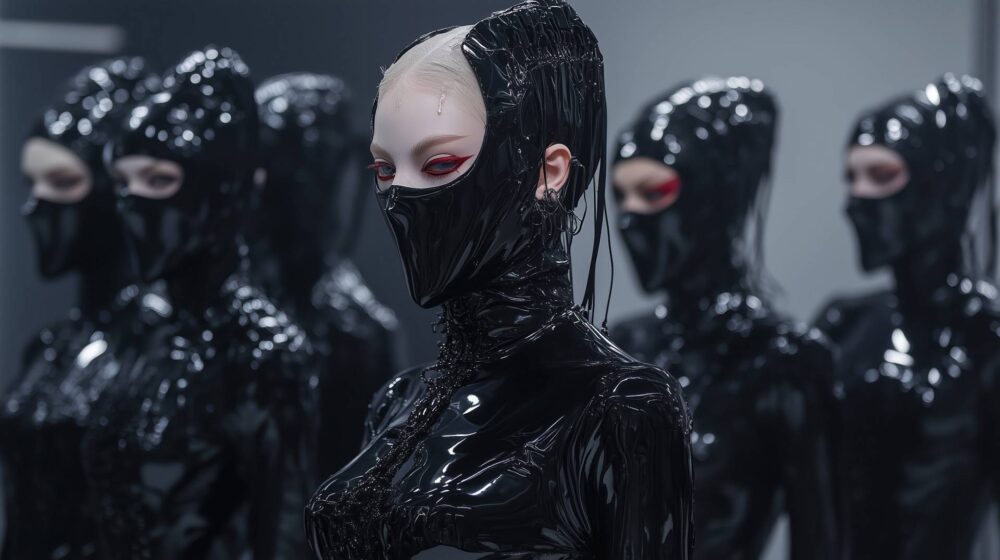
The aesthetic of Hybrid Collapse is cold, ritualized, lush, and coded. Dark latex, faceless priestesses, choreographed stillness, flooded ruins — these are not simply stylistic choices, but arguments in visual form. Every video acts like a silent myth: compressed, symbolic, haunting.
The body is central, but never natural. Often duplicated, armored, contorted, the figures are neither erotic nor neutral — they are tools of power, vehicles of resistance, zones of control. They reflect not individuality, but the systems through which identity is produced.
In this, Hybrid Collapse builds a visual grammar for the posthuman: beautiful yet unnerving, clean yet violent, intimate yet schematic.
Sound as Atmosphere, Not Product
The music of Hybrid Collapse refuses easy classification. Glitch, ambient, industrial, and synthetic pop flow into one another without apology. Vocals are processed, ghostly, fragmented — less expressions of self than echoes of systems.
But more than genre, what defines the music is its function: it builds atmosphere. Each track is designed to immerse the listener in a cognitive-emotional zone — not a song to consume, but a space to inhabit. The sound does not explain; it opens.
This ambient strategy aligns with the project’s conceptual goals. Music becomes a form of spatial thinking — a soundtrack for collapsed systems, broken subjectivities, and suspended meanings.
Thinking Without Preaching
What truly sets Hybrid Collapse apart is its commitment to thought — not as opinion or message, but as structure. The theoretical essays that accompany each piece are not academic add-ons; they are maps. They draw on philosophy, political theory, and media critique — but remain readable, poetic, and fragmentary.
This post-theoretical attitude — rigorous, but emotionally charged — reflects a broader shift in how culture thinks today. Not by argument, but by atmosphere. Not by explanation, but by resonance. Hybrid Collapse captures this perfectly, building meaning without reducing mystery.
A Culture-Bearing Project
In a time when art is often reduced to content, and thought to opinion, Hybrid Collapse insists on being neither. It treats the cultural moment seriously — not with slogans, but with structure. It offers no utopias, no futures, no purity. Only a mirror: one that reflects a world where machines dream, bodies perform, and theory flickers in pixels and reverb.
This is not escapism. It is lucid immersion. A form of presence inside systems that feel overwhelming — made visible, audible, and thinkable.
Conclusion: Toward a Poetics of Collapse
We don’t need more answers. We need deeper questions — rendered not only in text, but in image, sound, and structure. Hybrid Collapse is one possible blueprint for this kind of cultural work. Not a brand. Not a trend. But a proposal for how art can once again be a site of real reflection.
When the old categories no longer hold — music, video, essay, art, philosophy — Hybrid Collapse doesn’t choose between them. It connects them. And in that connection, it becomes something else: a poetics of collapse, assembled from the fragments of what we thought we knew.