
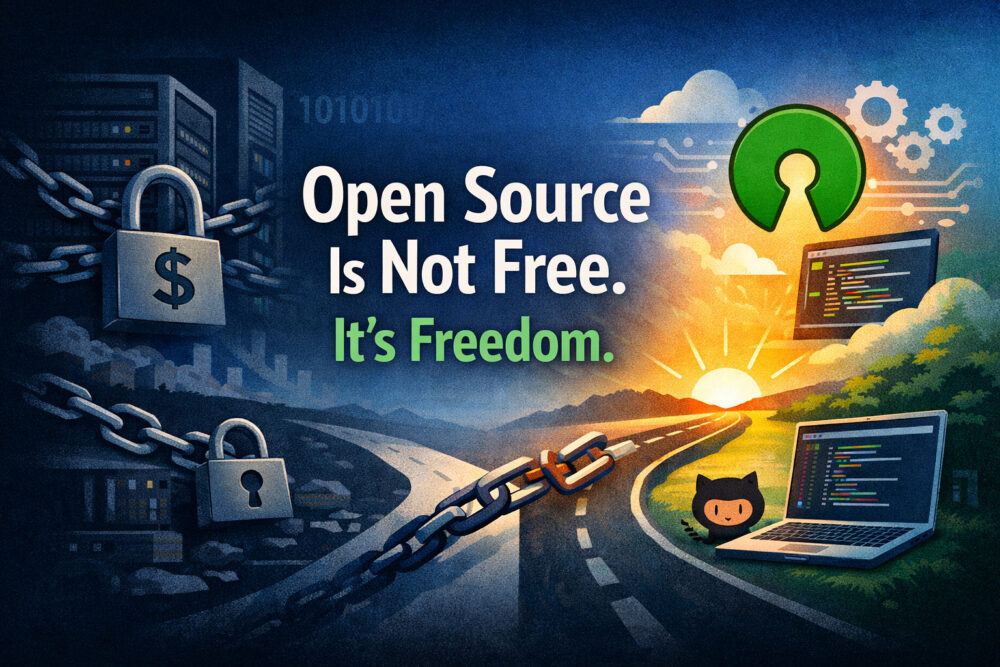
For years, “free” has been the word most commonly associated with open source.
And for years, that misunderstanding has caused companies to dismiss it as risky, unfinished, or suitable only for hobby projects.
The truth is simpler — and far more important: Open source is not about price. It’s about freedom.
The Hidden Cost of “Free” Software
When companies evaluate software, they usually compare licenses, subscriptions, and implementation costs. What rarely appears in spreadsheets is the cost of dependency.
That cost emerges when:
-
customization requires vendor approval,
-
pricing changes without negotiation,
-
data is stored in proprietary formats,
-
or strategic decisions are limited by one provider’s roadmap.
At that point, software stops being a tool and becomes a constraint.
What Open Source Really Changes
Open source does not remove responsibility or investment.
You still pay for infrastructure, people, and development.
What it removes is forced dependency.
With open source:
-
you can inspect how the system works,
-
adapt it to your business processes,
-
decide when and how to upgrade,
-
and retain full ownership of your data.
This shift — from dependency to control — is where real value lives.
Why CRM Systems Are Especially Affected
CRM platforms sit at the core of sales, marketing, support, and management.
When a CRM becomes restrictive, its impact spreads across the entire company.
Over time, teams stop improving processes and start working around software limitations. Innovation slows, and costs rise — not because the business is failing, but because the system can’t evolve.
This is one of the reasons why a growing number of companies are rethinking how they approach CRM.
A Practical Example: Defalto
This challenge was one of the main reasons Defalto was created.
After years of working with proprietary and semi-open CRM platforms, the Defalto team saw a repeating pattern:
-
increasing customization costs,
-
limited control over data and deployment,
-
and long-term dependency on vendor decisions.
Instead of building another closed SaaS product, Defalto was designed from the beginning as an open-source, self-hosted CRM — with transparency, modularity, and freedom as first-class principles.
Not to eliminate cost, but to eliminate lock-in.
Open Source as a Strategic Choice
Choosing open source is not a technical preference.
It’s a long-term business decision about:
-
who controls your systems,
-
how flexible your processes can be,
-
and whether your software supports or limits your strategy.
Open source is not always the right answer — but it should always be part of the conversation.
How to Decide Correctly
The real question is not “Is open source cheaper?”
The real question is “What happens if we need to change?”
There are clear criteria that help companies evaluate CRM platforms and avoid vendor lock-in — regardless of whether they choose open source or proprietary software.